
By Michael Downing
JRR Tolkien
In the last post, I wrote about Poets’ Corner at Westminster. At the end of that essay, I mentioned how I was disappointed by the fact that JRR Tolkien’s name had not yet been included at the Abbey.
So let me say it: JRR Tolkien (1892-1973) is a giant of English letters and deserves to be in honored at Westminster Abbey.
2023 marks the 50th year of his passing, so now is the time.
I’ll let you read his Wikipedia page for all the factual details but let me say that my love affair with the writings of JRR Tolkien begin when I was in the 6th grade. I was 12 and I devoured books. I grew up in a household where one parent loved me very much and the other made me into the target of abuse, so reading–along with the woods–were solace for me.
And how my heart leapt up when I heard Treebeard say to Merry and Pippin: Nobody cares for the woods any more . . . even as I was reading the actual book, perched in a tree in the woods along a creek about six blocks from my house.
Reading as a Kid
I’ll get to Gandalf in a minute, but I want to cover some of my reading experiences as a youngster. I read a ton of paperbacks on our home bookshelf, which I am eternally thankful for. My time in grade school was filled with reading. I would sometimes be ahead on classwork so I would get a Library Pass to go to the library and read. As a teacher now, I see the wisdom in this: Teachers would let trustworthy students who were caught up on their schoolwork occasionally go to the library where we could read. And we did. I can remember Stephen Buckel, Carolyn Sanner, Deborah Petroff, and Christine Polanski in the library, reading quietly.
For the record, I come from a lower-middle class neighborhood and was lucky for that because the neighborhoods that surrounded mine were very poor. So, in that environment, being granted the kindness of going to the library so I could read on my own (and so that the teachers in the original classroom could assist students who additional needed help), was both a blessing and a privilege for me. Makes me relate to August Wilson who was also on his way to reading every book in the [Carnegie] library. Makes me thankful for the teachers are my grade school.
Toward that end: My grade school is now closed. The high school I attended is now closed (more accurately: rebuilt and converted into a middle school, but there is no more high school). They even have been threatening to close the college I attended as an undergrad (Clarion University of Pennsylvania) but that was saved from the executioner’s ax through the magic of consolidation.
But the essence of what I’m trying to express is my gratitude to TEACHERS AND LIBRARIANS AND SUPPORT STAFF for the opportunity to be able to read so many damn books throughout my life. Thank you. You have given me everything I needed to grow and contribute to the world.
When I was a kid, I read our encyclopedia set pretty much from beginning to end. I also read almost all of Webster’s New Collegiate dictionary. I was fascinated by the endless amount of knowledge that you could pull out of a book…the magic you could develop through language (I’ll get to Gandalf in a minute).
I remember being amazed at how I could actually sit and read the dictionary. How do you “read” the dictionary? It’s random and just takes patience. Look up a word and it leads you to other words and it leads you to etymologies and pretty soon you’ve spent 45 minutes hopping from word to word and reading the synonyms, antonyms, and origins.
I understand that Malcolm X read the entire dictionary when he was in prison (and actually copied words, definitions, and punctuation). I’ve always appreciated and related to his work in that way.
Back to Tolkien
I got my start on The Hobbit in 5th grade (I was 12). It was an easy read and I enjoyed it.
I think I’ve read The Hobbit five times and I’ve listened to is on Audible at least once (and sometimes I just put on a chapter to drop into that world). From there it was on to The Fellowship of the Ring and the entire trilogy. I remember enjoying the heck out of it: the hobbits, the elfs (elves..lol), the humans, the wizards, the lore, the maps…on and on. Then there was the fun of connecting with other Tolkien fans.
Later in life I came to know more about Joseph Campbell and the Hero’s Journey and eventually when I taught at Butler County Community College, I had students read The Hobbit in English I. Then we would look at Campbell’s heroic journey and talk about movies and books that fit that journey.
David and I would dig into the scholarship: We learned that the names of the dwarves are from Snorri Sturluson’s The Prose Edda. We considered the specifics of the LoTR publishing history and Tolkien’s relationship with Allen & Unwin as gleaned from the Letters of JRR Tolkien. We developed an understanding of how WWI shaped JRR Tolkien, and, of course, we engaged in an ongoing application of Joseph Campbell’s ideas to the entire Tolkien universe.
I do remember getting bogged down at a couple of points in my LoTR reading when I was a youngster. The war scenes in The Return of the King were a bit heavy for a 13-year-old reader. It was a slog to get through some of that, especially for a kid who was enamored with magic and trees that could talk. I wanted more of that. But for Tolkien, it was cathartic, so I say let it be.
I also remember–and this was hard on me at first–trying to keep Sauron and Saruman straight. How those names came out so close to one another is a mystery to me as a writer. There are actually rules for writers that say you should not give characters names that begin with the same first letter to avoid confusion. I know that rules are made to be broken and when you’re dealing with a genius like Tolkien or George RR Martin, then all bets are off. Still, it did cause confusion for me as a young reader (and I’ve seen others points that out, as well).
Fifty years later, as I reflect, I would guess that the name similarity comes from all the background work that Tolkien did. He created all of the stories, characters, and landscapes in great detail, so these I assert that the names “Sauron” and “Saruman” emerged from that universe fully formed. There was no not naming them by the names they already had.
I would need to do some research on this or talk to a Tolkien scholar, but that was a big obstacle for me when I was a youngster, trying to understand–without internet–which one represented which specific path of evil (Saruman: corruption and Sauron: rebellion). Then Peter Jackson came along with the movie trilogy. Christopher Lee will forever be Saruman for all of us, so problem solved.
Of course, beyond that, I had great love for Bilbo Baggins and the other Hobbits and the various characters that emerged in LoTR: Gimli and all the dwarves; Legolas and all the elves; the Goddess Galadriel; Aragorn and Boromir. I loved all that myth, but my guy was always Gandalf (and I know I’m not alone in that).
But how about this: I’ve actually modeled my life on Gandalf. When I was young, I loved him because he saved the day. He also knew cool lore and could cast magical spells. What’s not to like? But once I became an adult and understood more of Joseph Campbell, I began to see Gandalf as an archetypal character who opens the door to eternity.
It is through Gandalf that I started to understand nature magic which took me into Paganism which took me into Buddhism, with Joseph Campbell and Alan Watts accompanying me for much of the journey. In this way, Gandalf and JRR Tolkien have had life-changing influence upon my life, and for that I am eternally thankful.
Joseph Campbell
I’ve known about Joseph Campbell since undergraduate years, springing out of my study of Freud and Carl Jung. Campbell did me and the world a huge favor by coalescing the worlds of art, literature, psychology, philosophy, and anthropology to give us a framework to more effectively study mythology. All of this opened the door for literary scholars such as David and I and we’ve been on the case ever since.
There is much to be written here, and I hope to get to all of it someday, but I’m going to go ahead and invoke Campbell here for the sake of humanity. Before he passed, he said that humans needed to adopt a shared mythology that was focused on Mother Earth. We need to transcend boundaries, both cultural and geographical, and begin to understand that the Earth is our Mother and needs to be treated with care and respect, lest we face dire consequences (as I type, the air quality rating is 186, which is dangerous).
But on to Alan Watts. I got into Watts a bit later, about my mid-twenties. I’ve learned that some people don’t really like Alan Watts for a variety of reasons, although he has a significant following. But I find the guy hella entertaining.
He understands that he is a philosophical entertainer with an eye toward the mystical, so it’s mostly not going to be a straight-up academic paper (although he is certainly fully capable of that). But he actually did the legwork on Buddhism, visiting Japan four times and paying special attention to Kyoto, arguably the heart of Japan’s religious culture.
I practice Buddhism, as best I can in Western culture. It makes you different from most of American culture, that’s for sure. Practicing gratitude in a culture that rants all the time and practicing non-judgment in a country that is taught to judge are two examples. To always ask is this necessary? in a country that has the gas pedal to the floor in terms of money, food, drugs and alcohol is a challenge. But I just move along quietly, using my Gandalf wizard skills to pull what Jackie and I need from the universe.
I will say that the Western World can gain so much from Buddhism. Campbell knew it; Watts knew it; others, as well. Hell, Gandalf knows it.
But to close out Watts: Once he starts getting cranked up on the practices and meanings and subtleties of the Buddhist path, he is absolutely hard to beat.
Back to Gandalf
But back to Gandalf. I play a lot of video games so if you were to ask me what archetypal character I am (from Diablo IV, let’s say):
Barbarian
Rogue
Amazon
Necromancer
Wizard
I would most definitely be the wizard. I am not an ax and cudgel buy, and I’m not a rogue. Necromancy belongs to those who know more about it and although I’m pretty good with a bow, my superpowers are wizardry. Now that I’m 60 years old, I would claim to be a level 60 wizard. Lol. This is kind of an ongoing joke between my wife and me, but it’s really not a joke. I fully believe that I have been able to access the divine through a mystical gateway opened by Tolkien through Gandalf, and I have raised my game year over year.
I teach writing, which is all spellcasting…combining words to achieve a desired effect. As a result, my work involves coordinating energies to manifest phenomena and bring them into the physical realm. I write, set intentions, express gratitude, think critically, create a timeline with a divination tool (Google Calendar), and communicate my ideas to the people who need to know. I am also able to communicate with nature, particularly trees, which–as I have argued for my entire lifetime–are intelligent and are able to communicate and cooperate with one another. So, short of a horse called Shadowfax, I have become Gandalf.
Gandalf. My heart would ache when he disappeared from the narrative and then rejoice when he would arrive again. He would travel and read and bring such wisdom to the group…deep knowledge of times past–I loved all of that. He knew about things that none of the fellowship knew about and that backstory was so compelling to me.
His character had so much potency because both Tolkien and Gandalf did their homework: Tolkien on creating the mythology and characters, and Gandalf, who traveled and consulted both people and tomes. Tolkien did so much work behind the scenes that he knew what the stories were and put the language directly into the mouth of Gandalf. There’s probably more to be said on this topic but I’m running long. Let me move on to the list of authors from Poets’ Corner and some of their works that I’ve read in my lifetime.
My Reading List of the Poets from Poets’ Corner
My brain has been clicking to connect the list of authors from Poet’s Corner to the works that I have read by those authors. My evolving list appears below.
Special shout out to Art Barlow, David Anderson, and Ralph Gammon—long-time literary friends—who have shared in and encouraged my study of literature.
It is, indeed, a life well-lived.
List
Geoffrey Chaucer: The Canterbury Tales
Edmund Spenser: The Fairie Queen (for Elizabeth I)
Thomas Hardy: Novels: Return of the Native, The Mayor of Casterbridge, Tess of the D’Urbervilles. Poems: “The Convergence of the Twain,” “A Sheep Fair,” “The Voice”
William Makepeace Thackery: Vanity Fair
William Wordsworth: “Composed upon Westminster Bridge,” “I Wandered Lonely as a Cloud,” “London, 1802,” “Tintern Abbey,” “My Heart Leaps Up,” “The Solitary Reaper”
Jane Austen: Pride and Prejudice
William Shakespeare: I have read at least 27 plays (of which, I believe, are 37 total) and dozens of sonnets. Plus the commentary/critical essays and history. It’s all essential to understanding Shakespeare. Favorites? This is a challenge, but Macbeth, Hamlet, and Midsummer Night’s Dream can’t miss.
Charlotte Bronte: Jane Eyre
Emily Bronte: Wuthering Heights
Ann Bronte: The Tenant of Wildfell Hall
DH Lawrence: Sons and Lovers, Lady Chatterley’s Lover, “Rocking Horse Winner”
Lord Byron (George Gordon): “When We Two Parted,” “She Walks in Beauty”
Gerard Manley Hopkins: “The Windhover,” “Pied Beauty,” “God’s Grandeur”
Robert Browning: “The Soliloquy of the Spanish Cloister” (a trip for a 20-year old trying to wrap his head around the literary world)
Alfred Lord Tennyson: “Ulysses,” “Morte d’Arthur,” “Break, Break, Break,” “Charge of the Light Brigade,” “Crossing the Bar,” “The Lady of Shalott,” “In Memoriam”
Ted Hughes: “Hawk Roosting,” “Telegraph Wires”
Philip Larkin: “Church Going,” “Toads”
Henry Wadsworth Longfellow (American): “Paul Revere’s Ride,” “Haunted Houses,” “The Rainy Day,” “Nature,” “The Children’s Hour”
William Blake: “London,” “The Tyger,” “The Lamb,” “I Saw a Chapel”
Slides
Slide below generated by DALL-E 2.
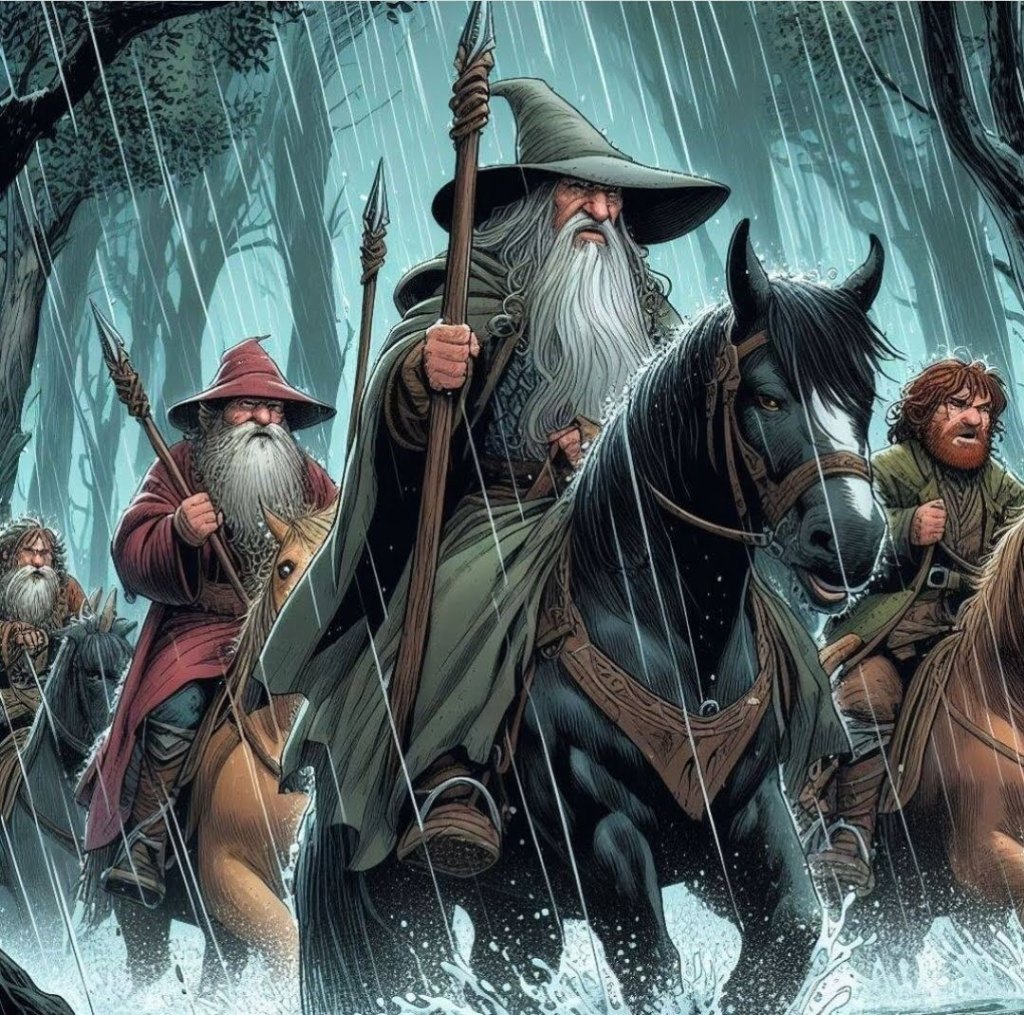
 My Writing Wanderland