
By Michael Downing
My World of Shakespeare
Back in the 1990s when I lived in Pittsburgh, I put together a full-time teaching schedule by teaching courses at various community colleges, including Butler County Community College, the Community College of Beaver County, and Community College of Allegheny County (Boyce Campus). My schedule was spread out between multiple schools, so I might, for example, teach a morning class at CCAC and then drive to Butler for afternoon classes and then back to Pittsburgh…a total of 75 miles (~2 hours of driving) on a typical day.
I listened to a lot of radio and a lot of CDs.
I also made a lot of cassettes: Music, mostly, but also a lot of literature. I was delighted to find endless vinyl holdings in the libraries of these schools—records that were seemingly only in demand by adjunct English Professors who were driving lots of miles each day just to keep head above water. In other words, they were mine for the borrowing.
And while I would certainly dig out some classics by John Coltrane and Miles Davis, along with Bessie Smith and Robert Johnson, my overriding focus was literature. I must have made nearly 50 cassette tapes of literary material and would listen every day: Robert Frost Reads His Poetry, Poems and Letters of Emily Dickinson, The Poetry of John Keats, Katherine Anne Porter: The Downward Path to Wisdom, The Romantic Poets (Volume One), on and on. I don’t have the cassettes anymore; they took water damage at some point, but I remember working to put all of that material onto the tapes and ultimately into my head.
It’s no wonder I love Audible.
Among my greatest focus was Shakespeare. It was one thing to read the plays in college; it was another thing entirely to listen as the voice actors brought the words to life. At one count, I had read/listened to 27 Shakespeare plays and then went on to read the associated academic material such as Shakespeare’s English Kings and a variety of interpretive essays and other material that put the entire canon into its critical and historical perspective. If you want some quick and powerful insight into Shakespeare’s work, look up Holinshed’s Chronicles on Wikipedia.
Although I am not considered a proper “expert” in the academic world of Shakespeare studies (they would crush me in terms of reference points; I’m an August Wilson scholar), but I can go pretty deep. Such as historical reference points in English history, how his plays are challenging because his plays are poetry, which adds another layer of difficulty for average readers. Plus, there can be as many as 60 spoken parts (see Henry IV, Part Two).
As a result, comprehension and appreciation takes a lifetime and the conversations and modern-day applications go on and on. Despite the challenges, it is also safe to say that most people can access and understand the major plays. Totally worth it, even if you just nibble at the edges.
Old English, Middle English, Modern English
I’ve had students reveal to me their believe that Shakespeare is written in Old English, and that’s why the understanding does not come easily. But this is not accurate. Nor is it Middle English.
I’ve added a quick comparative illustration below. Note how Old English is pretty much unreadable to non-experts. For its part, Middle English can be effectively translated with a little bit of work, while Modern English is entirely accessible to an English speaker who is willing to take the time to read carefully and allow the language to sink in.
These examples are all public domain, so I’m not going to link them to any single source.
Old English
Beowulf
Author Unknown
Hwæt. We Gardena in geardagum,
þeodcyninga, þrym gefrunon,
hu ða æþelingas ellen fremedon.
Oft Scyld Scefing sceaþena þreatum,
monegum mægþum, meodosetla ofteah,
egsode eorlas. Syððan ærest wearð
feasceaft funden, he þæs frofre gebad,
weox under wolcnum, weorðmyndum þah,
oðþæt him æghwylc þara ymbsittendra
ofer hronrade hyran scolde,
gomban gyldan. þæt wæs god cyning.
Middle English
Prologue to The Canterbury Tales
By Geoffrey Chaucer
Whan that Aprille with his shoures soote,
The droghte of March hath perced to the roote,
And bathed every veyne in swich licóur
Of which vertú engendred is the flour;
Whan Zephirus eek with his swete breeth
Inspired hath in every holt and heeth
The tendre croppes, and the yonge sonne
Hath in the Ram his halfe cours y-ronne,
And smale foweles maken melodye,
That slepen al the nyght with open ye,
So priketh hem Natúre in hir corages,
Thanne longen folk to goon on pilgrimages,
Modern English
Hamlet
By William Shakespeare
HAMLET
Let me see.
[Takes the skull]
Alas, poor Yorick! I knew him, Horatio: a fellow
of infinite jest, of most excellent fancy: he hath
borne me on his back a thousand times; and now, how
abhorred in my imagination it is! my gorge rims at
it. Here hung those lips that I have kissed I know
not how oft. Where be your gibes now? your
gambols? your songs? your flashes of merriment,
that were wont to set the table on a roar? Not one
now, to mock your own grinning? quite chap-fallen?
Now get you to my lady’s chamber, and tell her, let
her paint an inch thick, to this favour she must
come; make her laugh at that. Prithee, Horatio, tell
me one thing.
Modern English. You just gotta spend the time with the rhyme.
This is why I wanted to listen to the works. Plays are meant to be performed. I wanted as much in my head audibly so as to reinforce what I was reading in my beloved Bevington. During those years I also had season tickets to the Pittsburgh Shakespeare Festival, where I saw some 20+ Shakespeare plays performed over a four-year period.
The big bonus in this pursuit is that my great friend David Anderson from Butler County Community College has taught Shakespeare for more than 30 years. So when I would drive up to Butler, David and I would spend time over brown-bag lunches working through the latest scenes that I had listened to. I remember the histories and tragedies being a particular challenge: I couldn’t keep the characters straight. Every evening, I would have to open the plays and try to make sense of the dramatis personae.
Macbeth and the Power of Archetypes
I recall how our conversations related to Macbeth were some of the most intriguing because both of us—as literary scholars—love the behind-the-scenes detective work as it involves literary documents. Here is my meaning: The actual surviving document of Macbeth is thought to be a fragment, meaning that it is missing some scenes, which we both find fascinating. Even so, The Scottish Play has stood the test of time. There are also some outstanding movie productions, including Roman Polanski’s version which is widely available.
Apart from the textual mysteries, David and I would talk about the archetypal themes, including regicide and the long-time tradition of hosts welcoming guests into their homes and the associated expectations. David has gone on to research this recurring theme in some detail and has even referred me to a story related to a man who—once upon a time—was wanted by the authorities. He showed up at a manor house when the lord was away. The lord’s son encountered the suspect and told him to hide in a hay mound. Once the authorities arrived in hot pursuit, they were able to get the boy to crack and reveal the location of the suspect. The suspect was then taken away. When the man of the house returned and was made aware of the situation, he took the boy into a field and shot him because the boy violated the expectation that hospitality be given to guests, no matter the situation. Need the name of this story from David, but it gives you a sense of how our literacy conversations—now spanning 30 years—tend to turn.
This, of course, relates directly to Macbeth because Macbeth welcomes Duncan, King of Scotland, into his home and then murders Duncan in his sleep. A huge violation of the archetypal expectations discussed above, all of which brings about the demise of Macbeth, along with his murderous wife.
So, yes, Jackie and I were definitely going to go to the Globe Theater in London to see a Shakespeare play and we could not have been more excited.
Slide
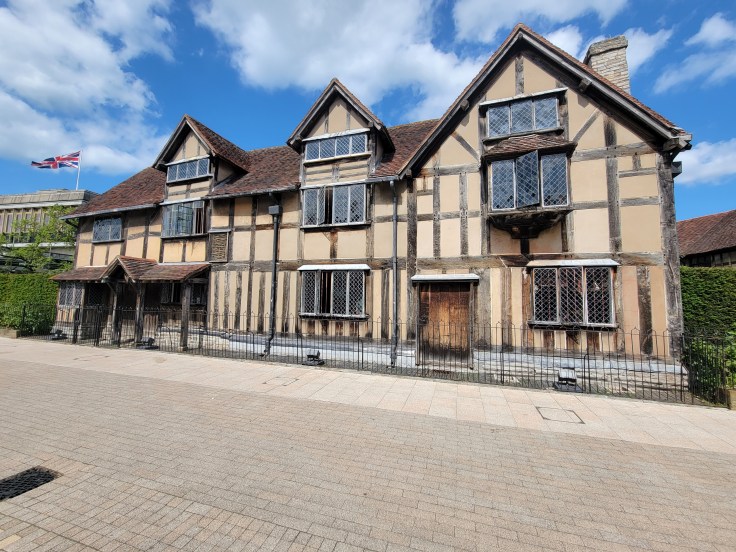
Shakespeare’s birthplace. Photo by Michael Downing.
 My Writing Wanderland