
By Michael Downing
Shakespeare’s Globe
The original Globe Theatre is where William Shakespeare staged his plays back in the late 1500s; Shakespeare’s Globe is the contemporary reconstruction of the theatee that is located near the original site.
As always, Wikipedia gives us verified facts quickly: “The modern Shakespeare’s Globe was founded by the actor and director Sam Wanamaker, and built about 230 metres (750 ft) from the site of the original theatre in the historic open-air style. It opened to the public in 1997, with a production of Henry V. The site also includes the Sam Wanamaker Playhouse, an indoor theatre which opened in January 2014.”
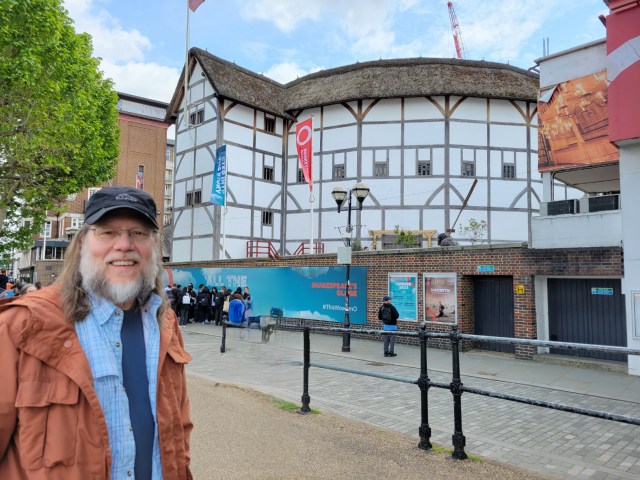
We walked along the South Bank of River Thames past the Tate Modern until we saw the round-little-white-walled-thatched-roof structure.
My heart leapt up. This was awesome.
People were taking pictures all over the place. There was excitement in the air. Humans from all over the world: Tall and short, light and dark, speaking different languages. All lining up to watch a Shakespeare play
There were eve some school-aged children on a field trip–what a field trip! Makes me think about the available schooling opportunities in London–got to be amazing.
We went through the ticket turnstile and onto the grounds. There was energy everywhere.
I had pre-ordered hard cider for Jackie and an ale for me, along with some chips, just to complete the experience. They didn’t have cider, so they gave her mead, which was delicious.
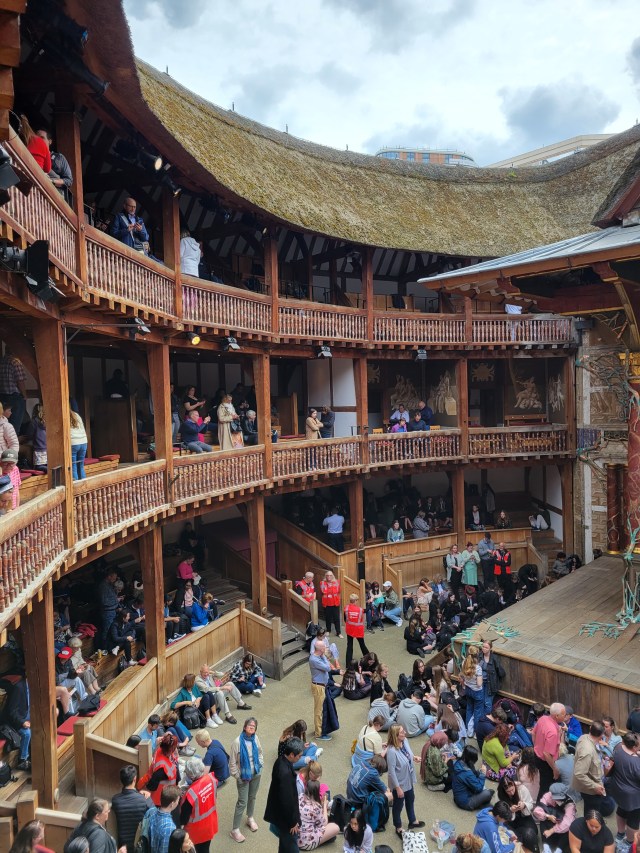
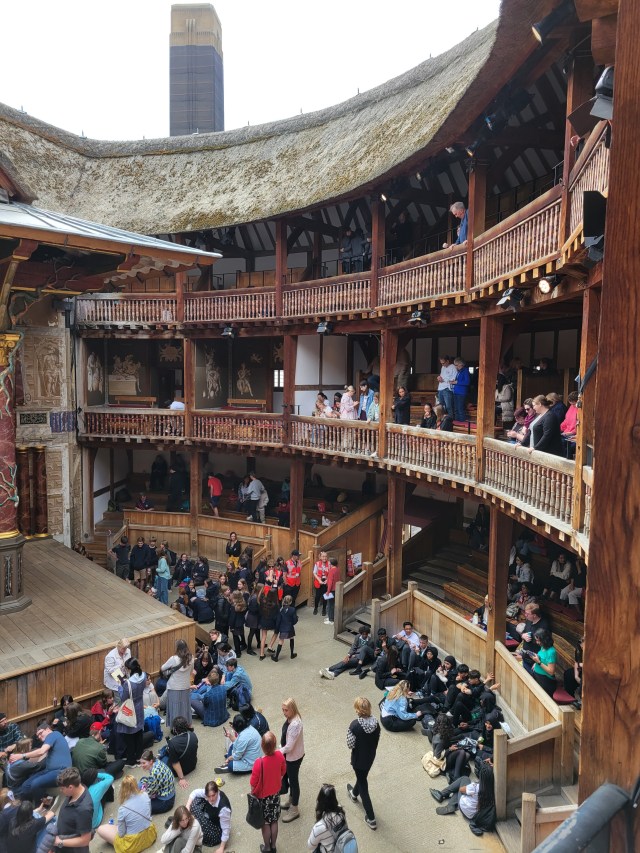
I also reserved seat cushions, which I recommend. We sat up on our perch in the sunshine, sipping our drinks, snacking on chips, and watching the events emerge.
It was glorious.
A Midsummer Night’s Dream
Reach back with me now a few months earlier when I started to dial into The Globe’s website. I think it might have been February 2023. The spring schedule had not yet been posted online and I was a little concerned that they might be running one of the more serious Shakespearian dramas…a tragedy or a history with 30+ characters and complicated backstory.
Please keep it light, please keep it light…
Four weeks later to my absolute delight I dialed into the website and found a glorious photo of Titania!
Alas, A Midsummer Night’s Dream would be playing when we were in London!
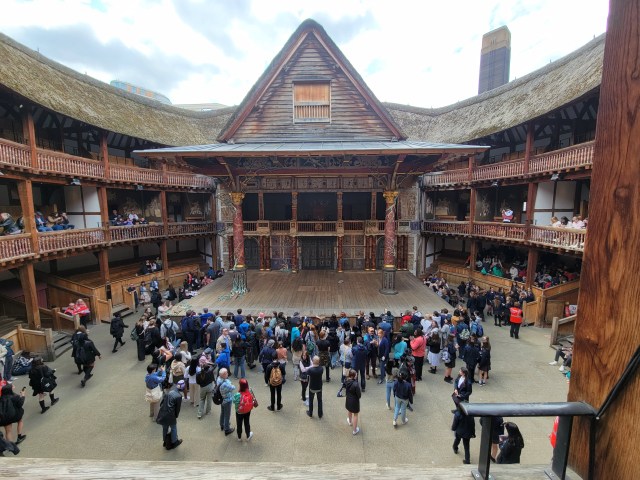
Accessible…comedic…entertaining. I was absolutely thrilled. Jackie was equally delighted. We had balcony seats with a direct view of the stage.
Best seats in the house!
The play was awesome. The costumes were inventive and the performances were excellent. We could hear every word. The play was bold and well-interpreted. And it’s difficult to set a historical date to the events. The initial setting is Greece, but the costumes were medieval and the interpretation of the narrative and accompanying tension were contemporary in terms of wit and intelligence.
Truly a sublime experience. We will never forget that day.
Nerd Mode: Drama is one of my areas of expertise within my discipline (English Literature and Theory). When I was completing my PhD at IUP, my three areas were American Short Story, Drama, and Literary Theory. That’s where I have my deepest reading. I’ve had a blast with all of it and should probably create blog posts on each of those categories and how that initial level of expertise has blossomed over time.
In drama, the human experience becomes real when spoken and performed on stage. It goes back to the Greeks and I’m sure beyond that. It begins with the utterance–the first actor—10,000 years ago—climbing up onto a stone at the end of town and becoming one character or another to the delight (and occasional confusion) of the gathering crowd.
At the very least, the artist was working out certain things affecting them. But as the art (and writing) improved, drama became a mirror for all humanity. Teiresias, when he tells Oedipus: You are the pollution. The scenes with Lady MacBeth. The drivers in August Wilson’s Jitney all reflect the human experience.
It is a mirror though which we learn and connect. Drama is how humans process their experience. Drama is necessary so that humans from different cultures who speak different languages can dial into the cosmic experience of people from other cutlures. In my view, there is no more imprtant thing than drama. We need to connect with one another in order to survive and drama provides the vehicle.
There is, today, a coordinated movement to crush student drama clubs throughout the US. Make no mistake, people who want to keep us permanently divided are the ones who will come after drama and books and speech. Kill drama and you kill schools…and I think that’s the strategy. School plays bring so much participation: Actors, direction, set building, lighting, ticket sales, advertising, supervision…there is more. So the danger of drama is that it pulls people in. That’s why the fascists want to kill drama. They want to divide and conquer us and, unfortunately, they’re pretty good at it.
The next chapter in this pursuit of drama is “How I Became an August Wilson Scholar” by Michael Downing. Lol. A discussion of my 30+ years as an AW scholar is definitely for another day.
Back to Midsummer
So, yes, Midsummer was great, but before I go, consider this: Shakespeare’s Globe had to put an “ableism warning” on the play because, according to The Times of London:
“In the production, which uses Shakespeare’s original language, Hermia, who is played by Francesca Mills, is described by the character Lysander as a ‘dwarf’, ‘bead’ and ‘acorn’, and is bullied by Helena before she fights back.”
Turns out the actor that played Hermia was a little person. When Lysander calls her a “dwarf,” the audience let out a collective gasp! It was right on the money. Before you get upset, know that this was entirely intentional on the part of the director and actor. They framed it up precisely in this manner to elicit this exact response from the audience and it landed like a hammerstroke. Brilliant.
It must also be said that the actor who played Hermia was quite arguably the best actor on the stage—truly a remarkable and convincing performance. Kudos to Francesca Mills! It was all quite perfect.
We wandered out of there happy as hell, River Thames to our right. We walked up the stairs and across the bridge and headed back to Soho where we ate tapas.
Slides
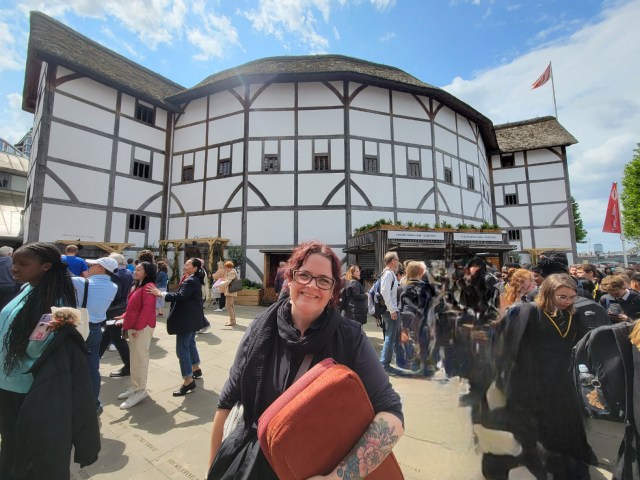
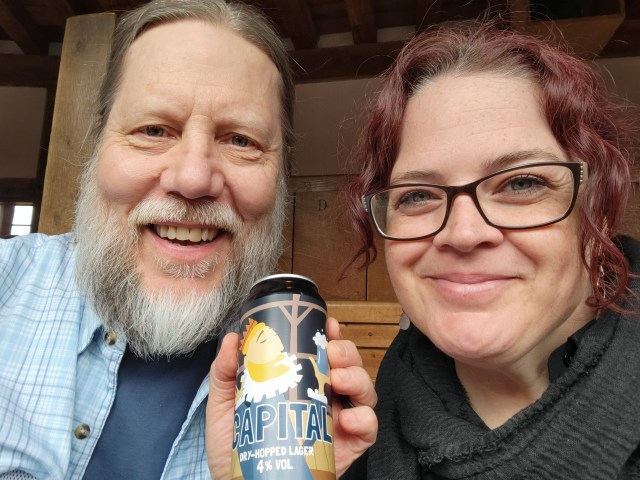
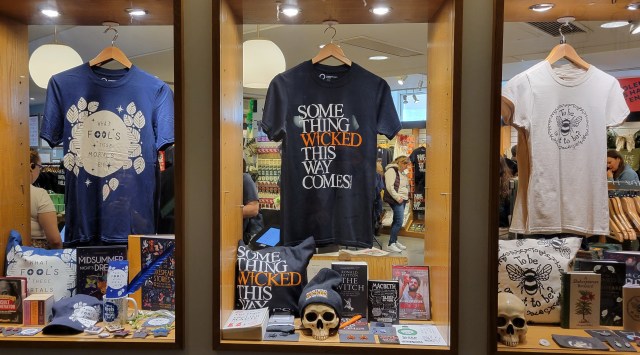
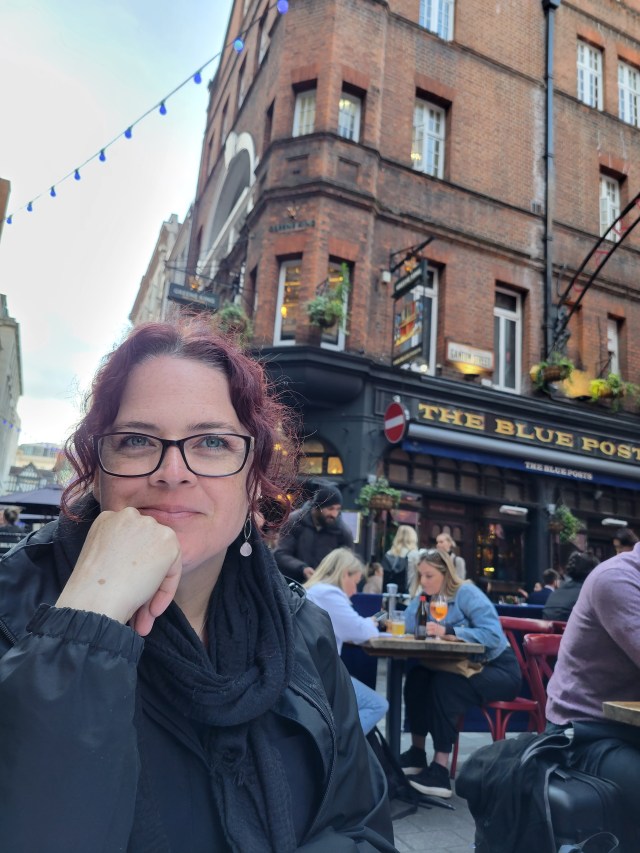
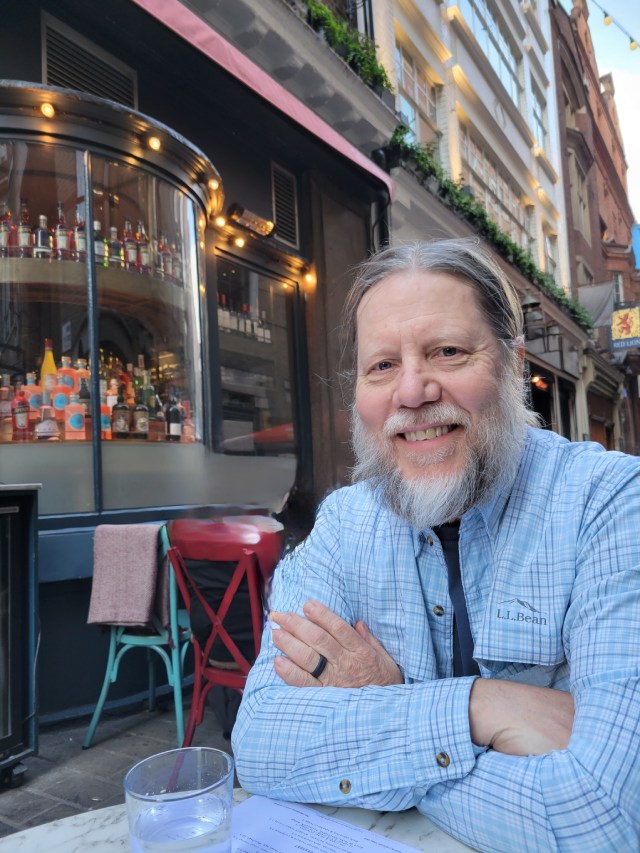
Below you’ll see pictures of me and then Jackie in front of Shakespeare’s Globe, the straight-on view from our seats, enjoying a drink, stage right and stage left, and a picture of the gift store window. The last two shots are back in Soho, having tapas in the cool evening air. All photos by Michael Downing.
 My Writing Wanderland