
By Michael Downing
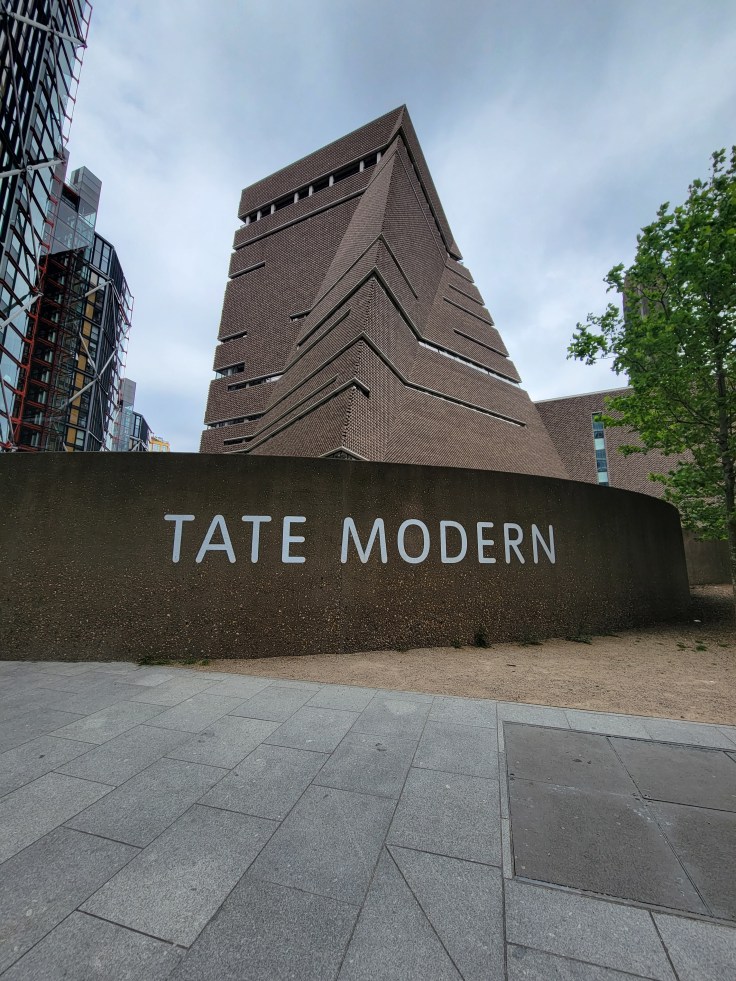
Tate Modern
Tate Modern is beautiful. Located on London’s South Bank, it houses “the United Kingdom’s national collection of international modern and contemporary art, and forms part of the Tate group together with Tate Britain, Tate Liverpool and Tate St Ives. It is one of the largest modern and contemporary museums in the world.
During our visit, the works of two artists were on special exhibit: Piet Mondrian (1872-1944) and Hilma af Klint (1862-1944).
Mondrian Wikipedia nutshell: “Pieter Cornelis Mondriann (after 1906 known as Piet Mondrian) was a Dutch painter and art theoretician who is regarded as one of the greatest artists of the 20th century. He is known for being one of the pioneers of 20th-century abstract art, as he changed his artistic direction from figurative painting to an increasingly abstract style, until he reached a point where his artistic vocabulary was reduced to simple geometric elements.”
I’ve loved Mondrian since my undergraduate days. I love his art and I love the story about how Mondrian went through his phases of learning and eventually reduced everything to “simple geometric elements.” It’s quite brilliant.
He began with traditional painting and if you follow along with his progression, you get to see and appreciate the entire phenomenon that was the development and—I’d argue perfection—of Piet Mondrian’s creative aesthetic.
One comment I’ve heard about Mondrian’s work—along with the work of other artists who make it look easy—is: “What’s the big deal? Anyone can draw lines and fill in the spaces.” Well…no, actually. First, he did it. You did not. He went through all of the learning and re-working and sacrifice to get to the point where his work transcended the world of art that he was born into—and now his work is celebrated all over the world.
He did his time as a painter of “realistic” pieces until he reached the point where, according to Dr. Stephanie Chadwick, it all came together in the abstract:
“[Mondrian] believed his abstraction could serve as a universal pictorial language representing the dynamic, evolutionary forces that govern nature and human experience. In fact, he believed that abstraction provides a truer picture of reality than illusionistic depictions of objects in the visible world.”
Examples of his work include @NewYorkTimes, @MOMA, @Artland.
Klint
Wikipedia nutshell: “Hilma af Klint was a Swedish artist and mystic whose paintings are considered among the first abstract works known in Western art history.” I was not so familiar with Klint but after learning about her, I think her artwork is great.
Examples of her artwork include @Guggenheim, @Vulture, @HilmaafKlintFoundation.
The Hilma af Kint website describes Hilma’s connection to mysticism and names Anna Cassel, Cornelia Cederberg, Sigrid Hedman and Mathilda Nilsso as amembers of a mystical club called “The Five.” They were active between 1896 and 1908 and “recorded messages from higher spirits referred to as The High Masters.”
The article states that the members would get themselves into “trancelike states,” and believed that they could “communicate with mystic beings with names such as Amaliel, Ananda and Gregor…transcribing their messages via automatic writing and drawing.”
Apparently, in 1907, af Klint claimed to have “received a message indicating that she should be the leader of the group.” The other four did not accept this move and the group disintegrated. af Klint then turned toward her solo artistic projects.
Right. Those were the big names at Tate Modern.
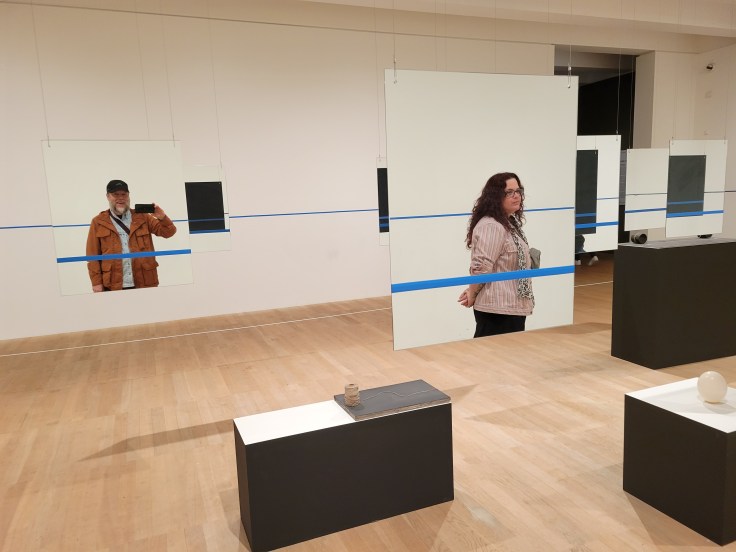
There is also a Free Collection and the highlights included Performer and Participant, where we got a great photo of the two of us looking into suspended mirrors. Materials and Objects, which was totally immersive, and Media Networks, which features the ways artists have responded to the impact of mass media over the past hundred years.
Finally, did you know that most of the UK’s galleries and museums are free? Truth. There is no admission charge for access to most collections, although donations are accepted (encouraged). Expect exceptions for special exhibits.
Mudlarking
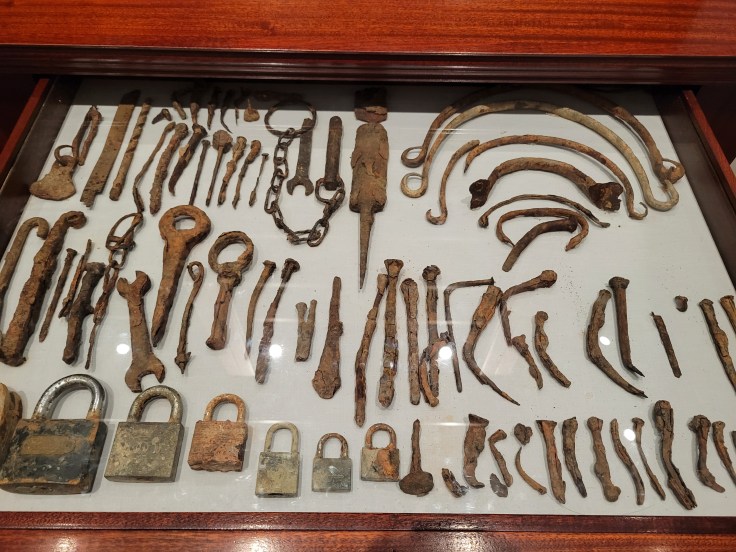
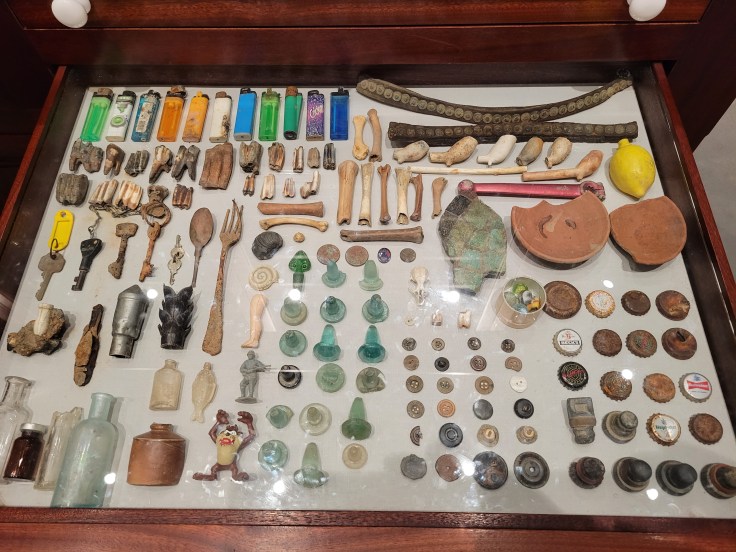
Before I close out Tate Modern, I need to get to mudlarking. Wikipedia says it involves “someone who scavenges in river mud for items of value” and there was a big display of artifacts from River Thames within the Tate.
London has been at the mouth of the Thames for thousands of years, so while some of the artfacts are as mundane as butane lightser, other artifacts include pottery, china, metal objects, along with pieces of glass and bone.
Modern mudlarks go along the Thames to scour the rocks and sand. They have to be licensed. They find all this stuff and share it with the museum for preservation. Super cool.
Slides


 My Writing Wanderland