By Michael Downing
with Reilly Fitzgerald
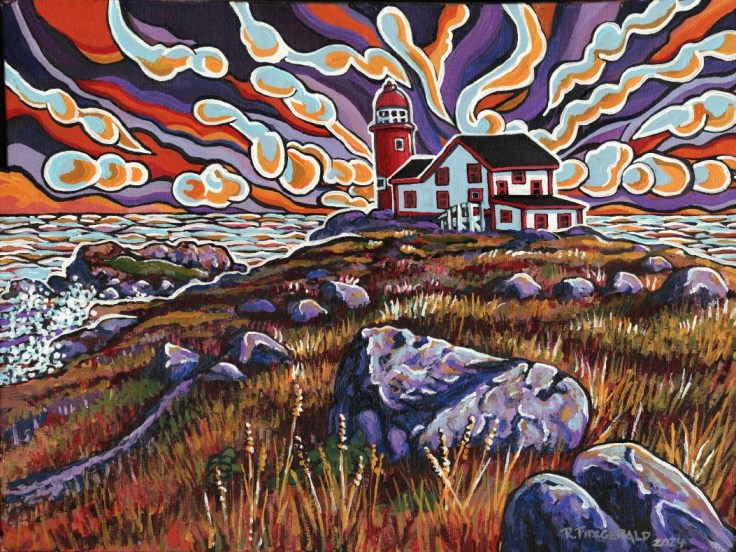
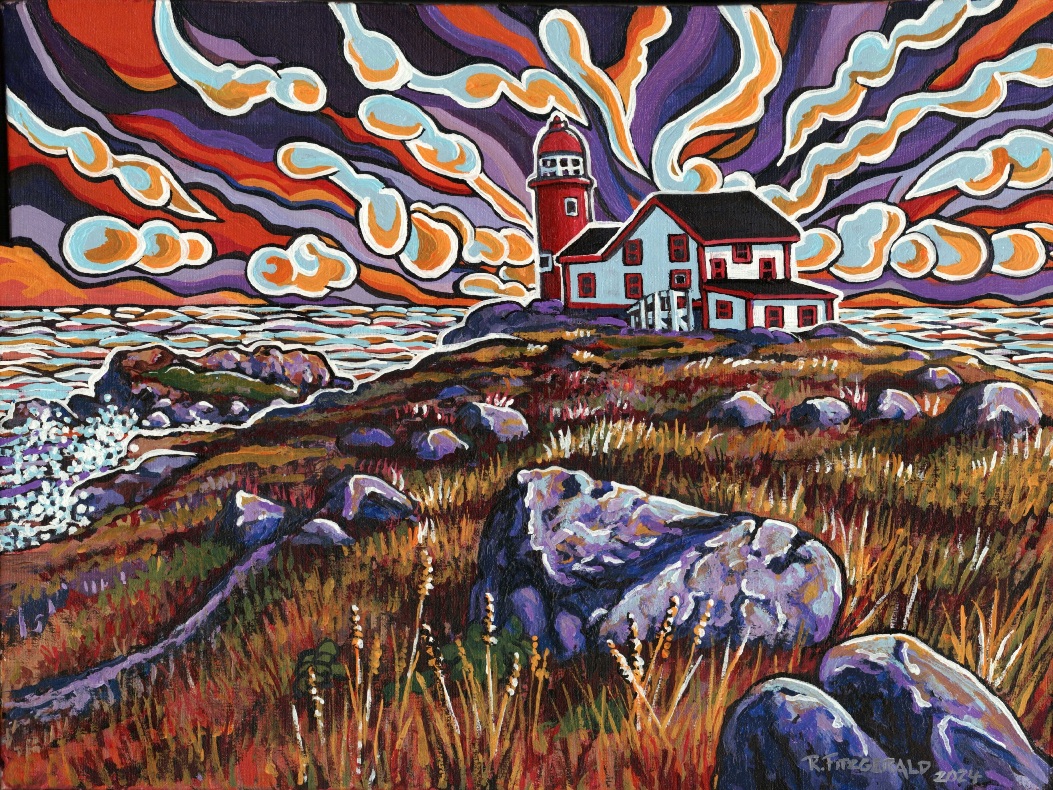
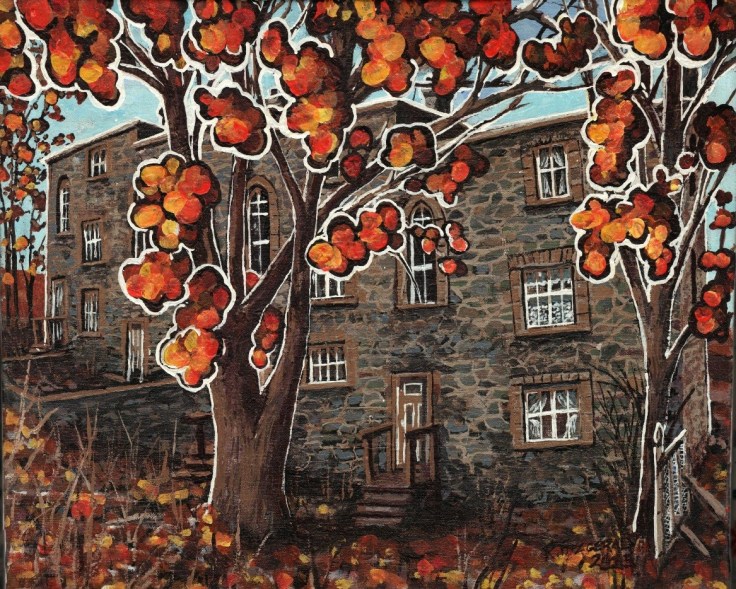
Many who see Reilly Fitzgerald’s art and learn of his long-term physical challenges note the juxtaposition between a life of pain and a painting style that consists of bright and colourful images. In other words, you might never know his pain simply by looking at his paintings.
Reilly said that, in his experience, many artists explore “style” in their early development, until they discover an expression that works for them and, maybe due to a motivation to sell and “please their public” they essentially paint mild variations on that style and subject over and over.
In contrast, Reilly tells me he regularly takes a “rather erratic approach to style and expression” and often paints in a particular style that moves him in the moment.
As someone who paints mainly as a therapeutic activity and as a means of releasing expressive energy, Reilly is really “not significantly concerned with sales,” he said. So he is constantly “tweaking the muses” and seeking different ways of expressing his art.
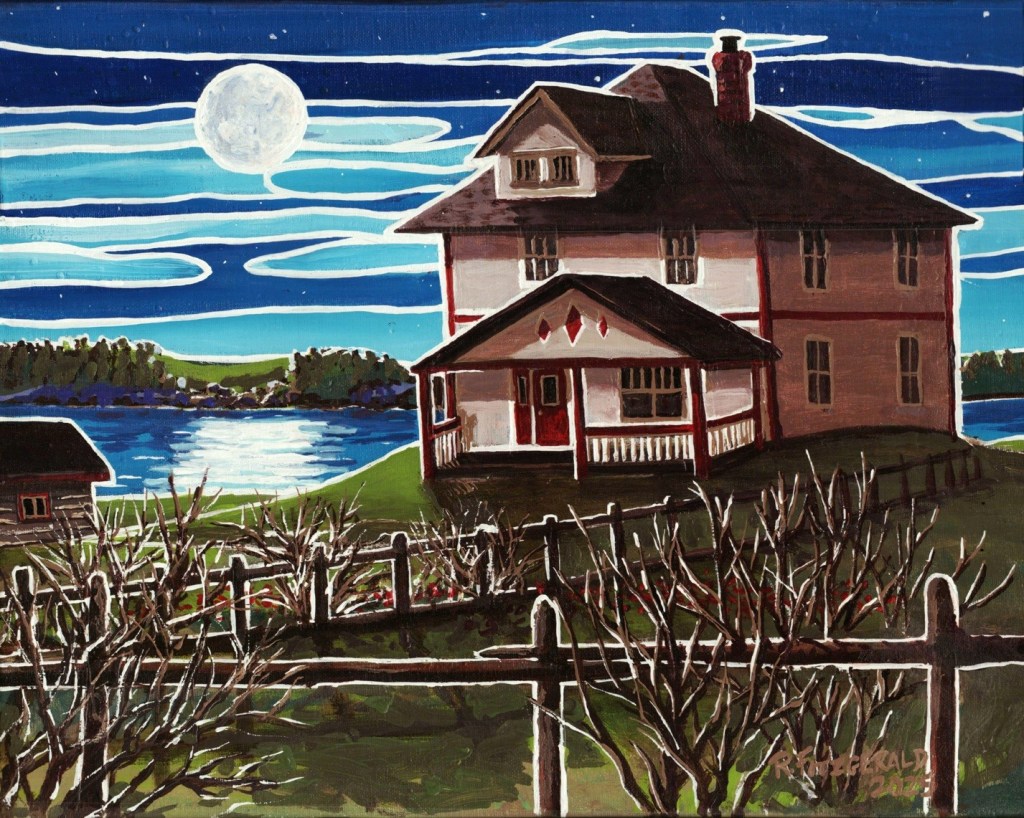
“Anyone looking at my work over any period of time will easily see this variation in my portfolio,” he said.
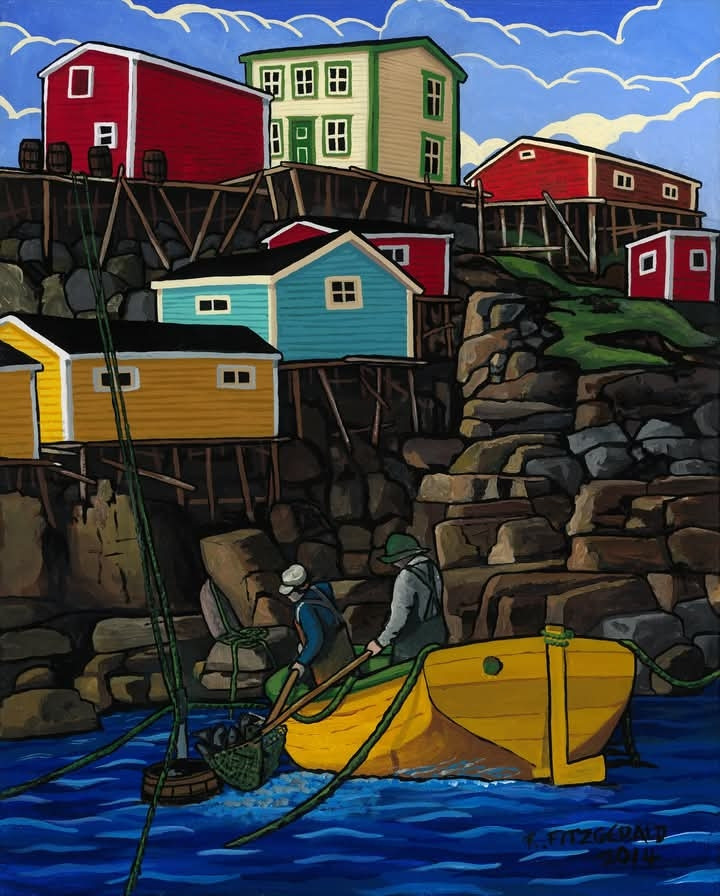
Sometimes he likes to test his skills by attempting to paint more realistic pieces. Other times he will be inspired by another artist’s work, or even by several artists, and be moved to put his “unique interpretation” on their approach, and then there are times when he simply starts painting a subject, allowing it to take him wherever it leads.
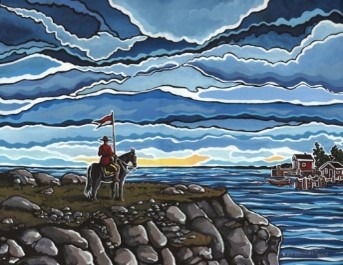
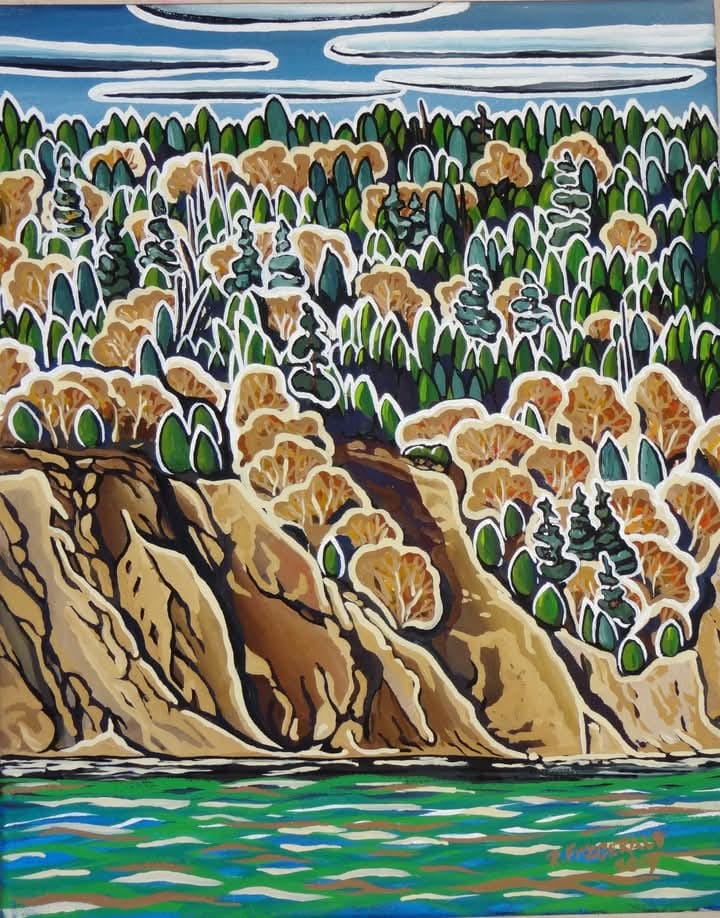
For example, in “The Cliffs of Random Island,” Reilly began the painting inspired by the work of Canadian artist Lawren Harris. “I planned a very simplistic piece,” he said. “As you can see, that did not happen, and my own style took over.”
On another note, this is a scene based on the view from our home in Clarenville, NL, and I don’t know if they exist, but I have not seen another painting of cliffs and ocean which looks anything like this style, and this is definitely one of my favourite pieces I’ve painted.
He told me once that a comparison of his art to the music of his generation would be that, while many artists can be compared to bands such as AC/DC or Def Leppard, who discover their signature expression and stick with it for a long, successful career, Reilly is more along the lines of Queen, moving from “Bohemian Rhapsody” to “Crazy Little Thing Called Love.”
He does admit that the notion of his art portraying positive and beautiful images–opposite to what one might expect from a person who has suffered so much–is accurate.
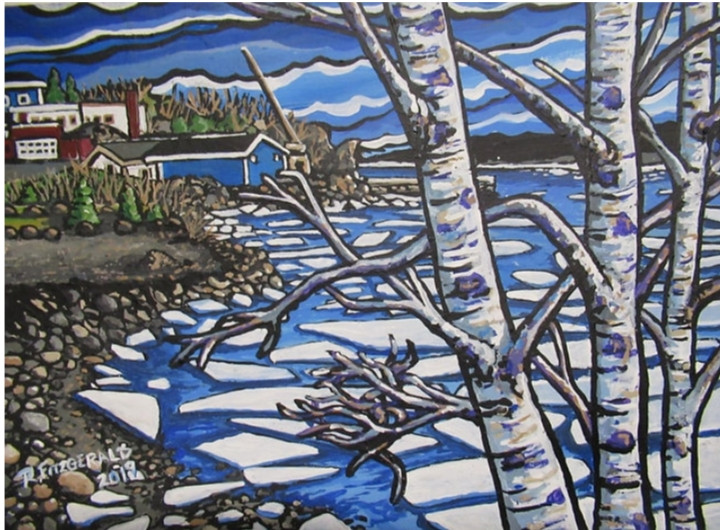
“My subject matter tends to evoke joy and positivity, even without the more expressionistic bold colours and outlines that have become equated with much of my work. This idea can even include my paintings depicting tragic events, as they generally tend to portray themes of survival and a determination to survive in the face of the most extreme adversity,” he said.
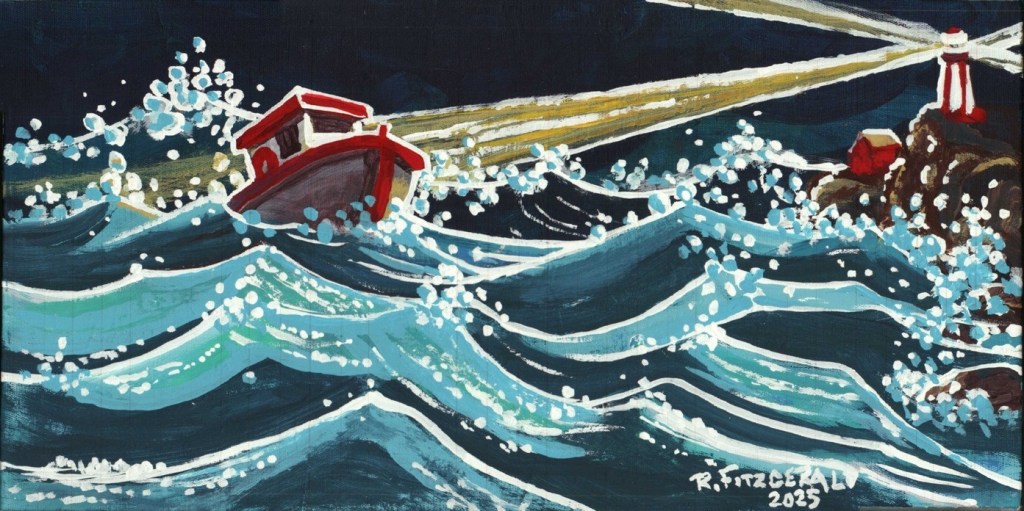
An example of this is “Riding It Out” (2025), which depicts a boat being buffeted by high seas–yet a lighthouse is near to provide hope and guide the sailors to port.
Before I close this post on Reilly Fitzgerald, I’d like to bounce back to the initial impetus that got me heading into these posts–and my friendship–with Reilly: The fact that I saw him as continuing the work of the Group of Seven Canadian Artists in the 21st Century. Now that I’ve developed some framework (and done quite a bit of reading), I feel like I can begin to make some direct comparisons.
Initial musings:
I can say that Reilly’s “Ice on Broad Cove Beach” (2019) (depicted above) looks like any number of Go7 works, particularly A.Y. Jackson’s Frozen Lake, Early Spring, Algonquin Park (1914).
I can also say that Go7 Arthur Lismer’s Seal Cove reminds me of Reilly’s “Grates Cove” (2014) (depicted above).
I can say that Lawren Harris’s Return from Church (1919) evokes comparison to Reilly’s “The Four Sisters, from Behind” (2025) (depicted below).
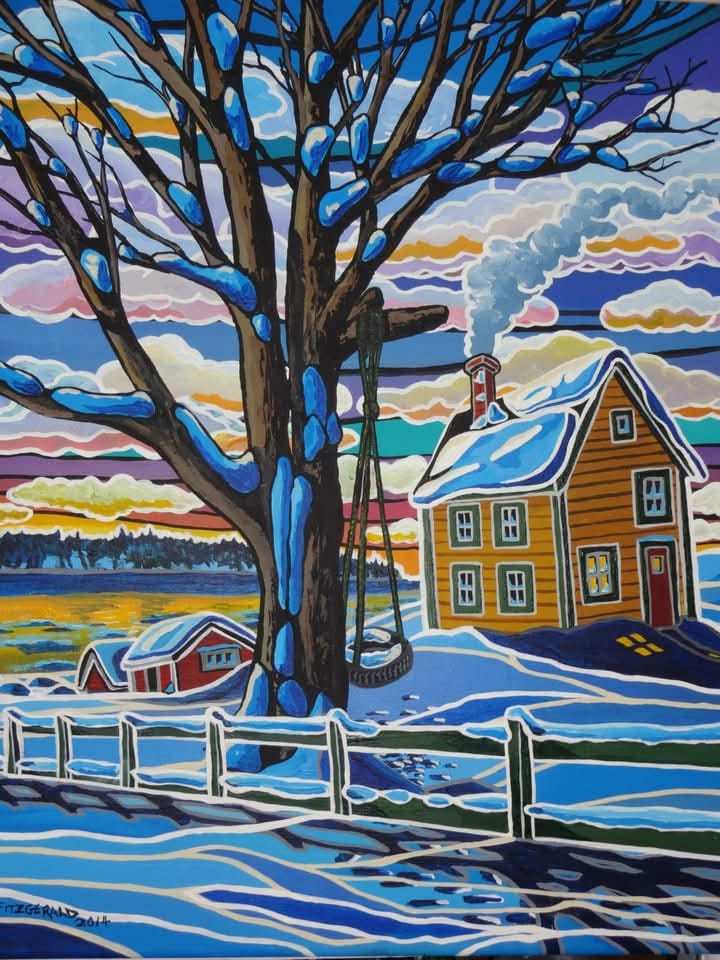
And I can say that Lawren Harris’s Red House, 1925 (1925) comes full circle for me. It was one of the first Go7 paintings I recall seeing in June 2024 at the Art Gallery of Ontario. I loved it and then went on to purchase the Reilly analog: “Winter Sunset” (2014) (depicted below).
 My Writing Wanderland
Leave a Reply