
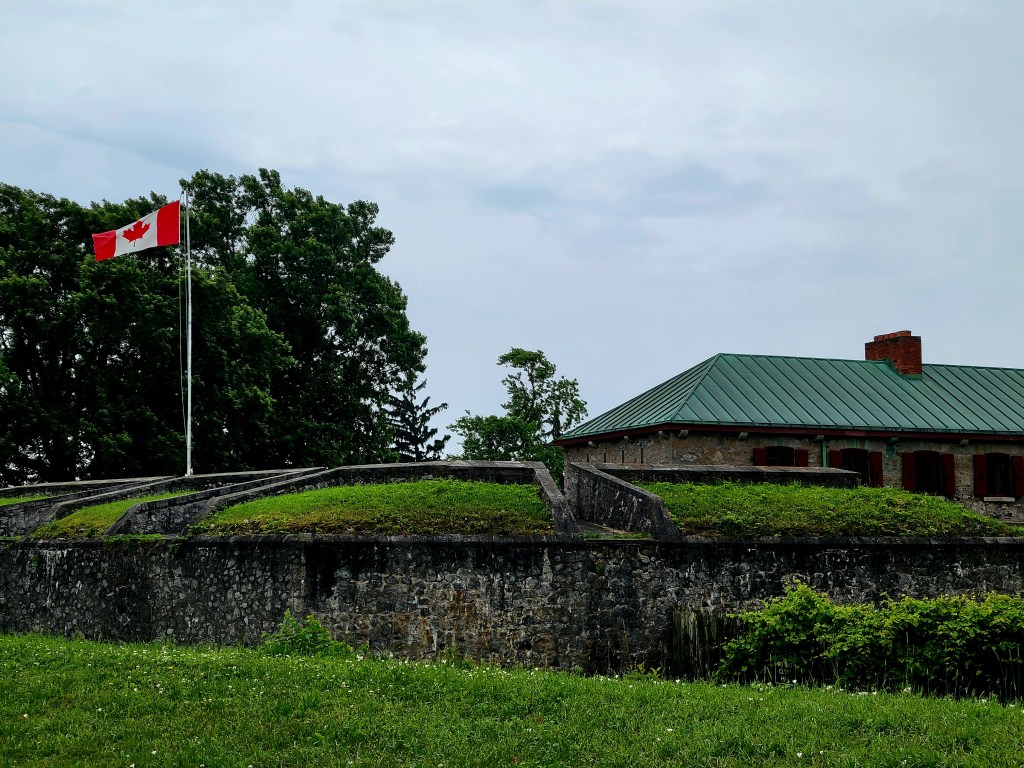
We left for our big 2025 Canadian Trip on July 1: Canada Day. We prepped the van and left Union City, headed north, up Route 89 to Interstate 90. From there a short drive into Buffalo and across the Peace Bridge. Customs went without a hitch and we wrapped around the tight right turn, out of Customs and into Old Fort Erie.

I knew that the Old Fort was connected to the War of 1812, but I didn’t know how. I know a little bit about The War of 1812 because my hometown, Erie, Pa., played a role in The Battle of Lake Erie. Mad Anthony Wayne didn’t give up the ship and they built the Wayne Blockhouse and I knew about Misery Bay at Presque Isle State Park. So I was familiar with quite a bit of the lore from the American side but I didn’t know much at all about the Canadian (which was, at the time, the British side, as Canada didn’t gain its independence until July 1, 1867, see Canada Day above).
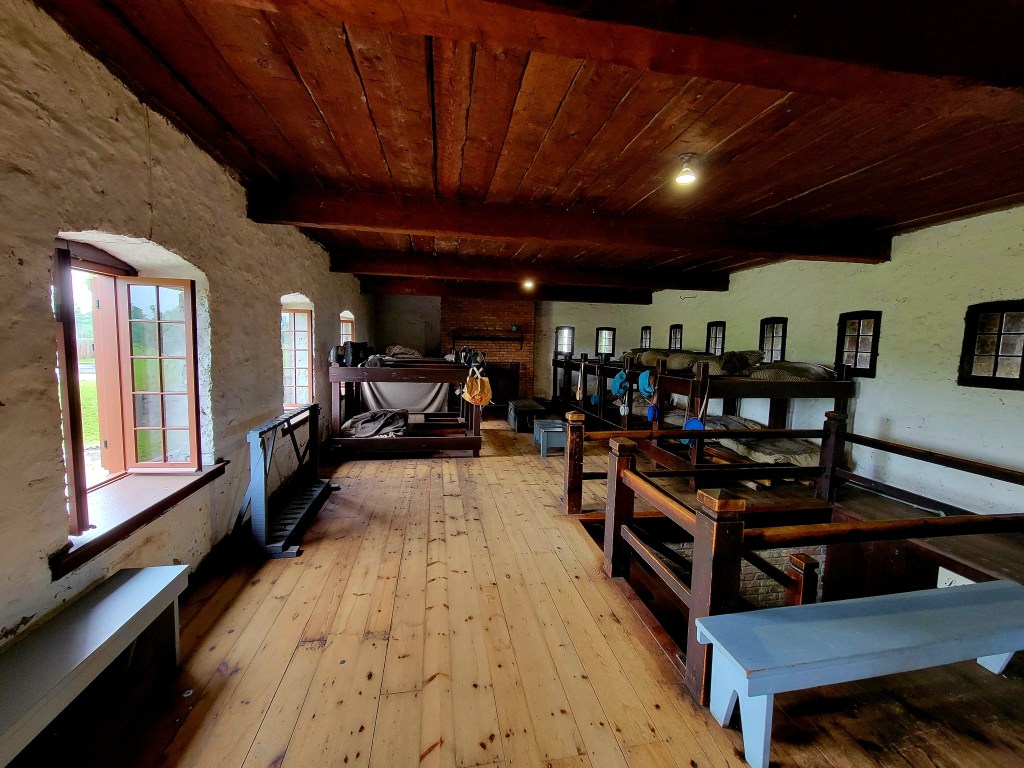
So the story on the Canadian side is that the Brits took the fort from the French (who originally built it) after the French agreed to abandon their claim to land east of the Mississippi. But, as you can imagine, the Americans didn’t want a foreign army lurking there, just across the Niagara River, so the Americans came across and chased them out.
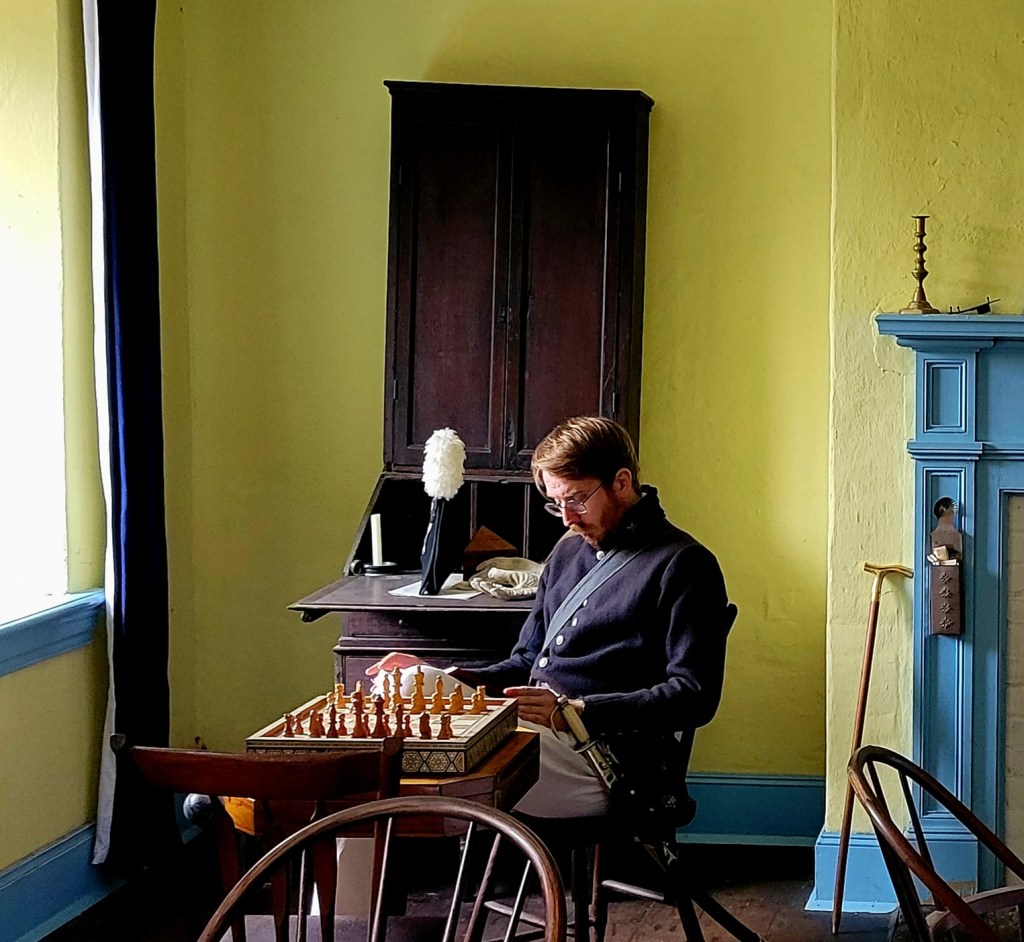
But it didn’t end there. The British said no way, man and the head Brit, having recruited indigenous assistance–came back and attempted to drive out the Americans. The lead British general made the determination that they were going to attack all at once.
Note: This was not a good idea. I’m no war general but, in my limited playbook, if I’m surrounding a fort, I’m going to cut off all supplies and starve you out. Keep my men safe, keep my men fed, while you suffer and eventually throw your guns over the wall, because you are literally starving. But apparently the decision was made to attack all at once and according to our human guide that was a bad choice.
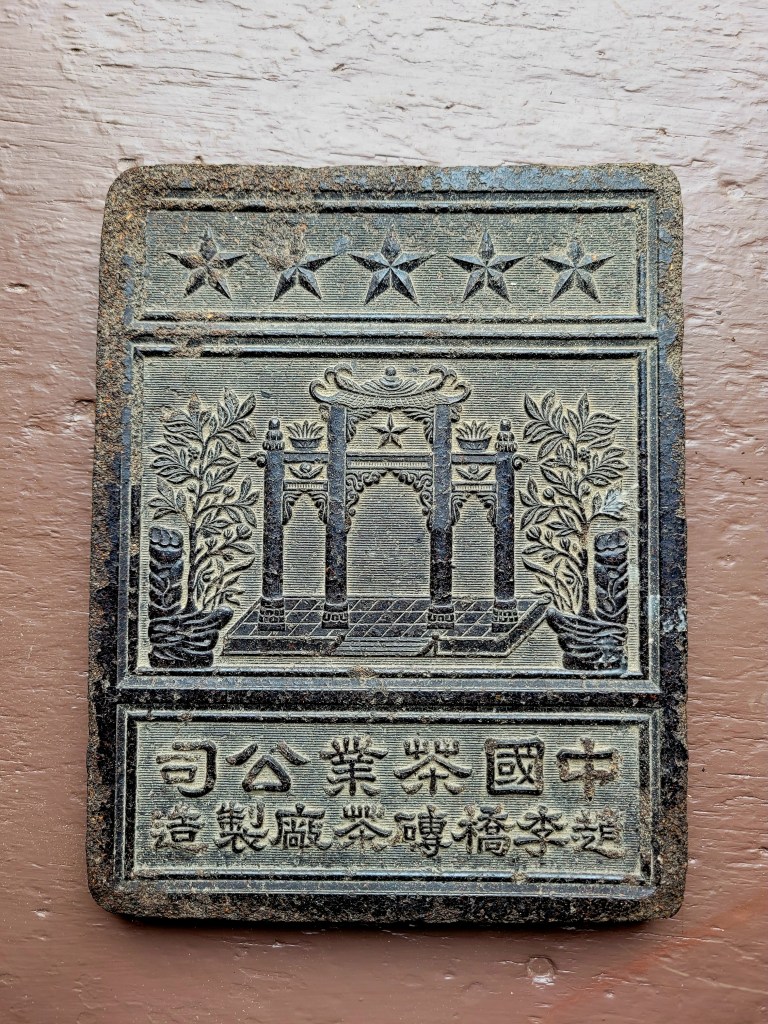
Turns out, on the west end, the British ladders weren’t long enough, and on the East End it was even worse. Apparently, 500 Brits managed to get over the wall–quite an achievement–but there, by some magic, was a huge gunpowder magazine directly below. The guide said they are not exactly sure how the magazine ignited–perhaps gunfire, perhaps a careful trap–but ignite it did and blew up 500 British soldiers. Not all of them died on the spot but apparently they had limbs blown off, fractured skulls, or internal damage and eventually died of sepsis or gangrene.
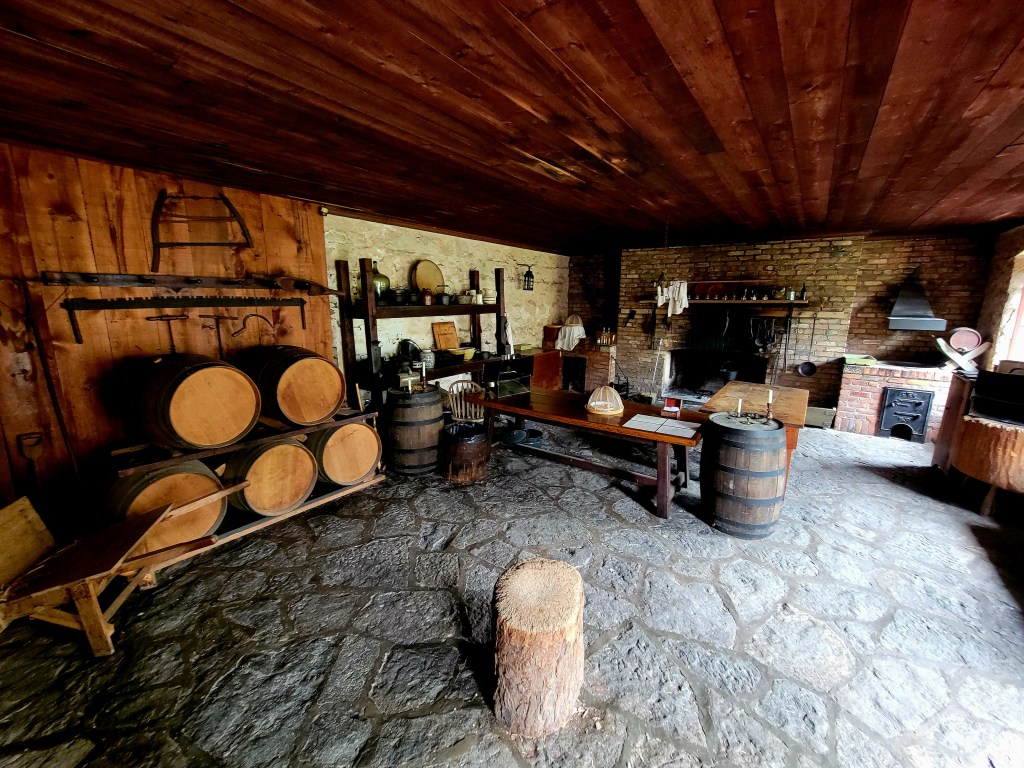
So the Americans were able to repel the Brits and the British struggled to get supplies and new soldiers. I believe the fort changed hands a few times…I’m not going to go down the rabbit hole on that right now though because I need to keep the travel narrative moving.
From Wikipedia: “In the early hours of 15 August 1814, the British launched a four-pronged attack against the fortifications. A well-prepared American defence and an explosion in the North East Bastion destroyed the British chance for success, and they lost more than 1,000 of their men.”
It did dawn on me that for the British soldiers to get supplies from Great Britain, the crates and barrels would have to come all the way across the Atlantic, up the St Lawrence, across Lake Ontario, and then over land to Fort Erie. No wonder they couldn’t hold it against the Americans. I suppose they had supply resources on the Canadian side, but if they wanted items that were specifically British–like guns–they faced some serious logistical issues.
After our tour, we climbed back into the van and talked quite a bit about Canadian identity. On the East end of the country, we could identify the Brits, of course, (King Charles III is on the CAD), the Scots, the French, and the indigenous tribes: the Inuit, the Metis, and First Nations. I believe there are also three million Germans in Canada and I believe the Spanish population is growing: directly from Spain directly as well as Latin American countries. I also believe Canada has the world’s ninth-largest Indian population, mostly in Ontario and British Columbia, followed by communities in Alberta and Quebec, with the majority being foreign-born.
Generally speaking, Canada views itself as being a “cultural mosaic,” rather than a “melting pot,” as the US is commonly described. The distinctions are important. In my experience, US citizens will accept people from other countries if they make a conscious effort to blend into American culture. I’ve actually been kind of astounded when I’ve gone into bars in red, rural America and seen Black people and Hispanic people walk in and be welcomed without question. They are welcomed because they have stitched themselves into the pattern of the dominant culture. I am not judging one way or another; this is just an observation, but I do think it’s a key observation for both the right and the left.
In contrast, Canada has seemingly been more tolerant of difference. Certainly not entirely tolerant, as we know related to historical treatment of indigenous peoples, but there has definitely been more progress on race than in the US. Canada is much further along in their evolving relationship with indigenous tribes, for example, as we see ongoing celebrations of indigenous art, music, and culture in many areas of Canada, including Montreal, Toronto, and Ottawa. Then there is French-speaking Quebec–an entire province–which the US would never allow. Could you imagine the state of Pennsylvania declaring its official language as German? Or Louisiana as Creole? They’d send in the troops. I’m less familiar with Western Canada, but it seems that Asian Canadians in Vancouver and Alberta are thriving, officially listed at 20% of the Canadian population.
None of this is to suggest that all Canadian citizens are happy with Canadian immigration policies. Many Canadians think in similar terms as their American counterparts, that immigrants should adopt the ways of their new country–more or less–so as to lessen the cultural upheaval. I don’t have the answers. My background is in reporting, not politics or sociology. My goal here is to try to represent all sides honestly with my writing, which could, perhaps, lead to greater understand of the issues by people of all political stripes, rather than hurling epithets, which is no way forward.
Personally, I believe politicians–in the US and Canada–have played both ends against the middle for too long. More precisely, elected officials have failed to craft adequate legislation to effectively manage immigration and now it’s causing real harm. In the US, politicians of both parties take money from donors who want to exploit cheap labor to pad their bottom lines, so the politicians close their eyes. Then those same politicians go to town halls and listen to their constituents tell them that there are too many immigrants who are coming into the country too rapidly and illegally, so they want limits. The result has been grossly mismanaged immigration policy.
People try to blame Joe Biden, but it’s been a problem for far, far longer than that. Gutless politicians from both parties, for decades, willing to let people suffer so they can pursue their selfish agendas, most of which are related to the rapid accumulation of money.

Anyway, after watching the Old Fort Erie historical video, taking the walking tour, browsing the gift shop, and having a snack, we drove to Crystal Beach.
My family didn’t go in many vacations when I was a kid. I remember going to Jamestown, Virginia, and the Strasburg Railroad in Amish Country. We also went to Washington DC at one point and made it to Toronto to see the Science Centre. Credit to my mom and dad for getting it together long enough to do a couple of summer outings, because my home life as a kid was mostly dysfunction.
But I do recall a trip when I was very young to Crystal Beach, Canada. There was an amusement park there called Crystal Beach Park. I think it was there for 100 years, closing in in 1989.
There were fatalities at Crystal Beach. According to Wikipedia, there were at least two deaths on the Cyclone roller coaster, one on the Comet, and one on the Backety Back Scenic Railway: “One of the most notable incidents was the death of Amos Wiedrich on May 30, 1938, on the opening day of the Crystal Beach Cyclone.”
Apparently, Wiedrich undid the safety harness and stood up to take off his jacket and was thrown from the car. Then he got hit by the same car because he fell to another track. His body was dragged 200 feet. Horrible stuff. An account from the May 31, 1938 edition of The Buffalo Courier Express is available here.
I remember going there as a kid. I was very young. Too young to go on any roller coasters or any fast rides. So if I was eight, my brother would have been 13 and my dad would have been 42 so they were all in. I remember watching the cars tracking up the hill and being impressed. I don’t remember much else.
Today, Crystal Beach amusement park is no longer there. It closed in 1989 and the rides were sold at auction. The Ferris Wheel went to Centreville Amusement Park in Toronto, The Comet was sold to Charles Wood and moved to The Great Escape and Hurricane Harbor in New York, and The Giant Coaster was bought for its cars and scrapped.
It’s all condos now but the pier that juts out into Lake Erie remains. We had a snack and moved on. There are many other little ports along the north shore of Lake Erie. I would have loved to visit all of them but you have to make choices when traveling so after going to Old Fort Erie and Crystal Beach and then making a stop for gas and ice we decided to make a straight line for Long Point, Ontario, Canada.
 My Writing Wanderland